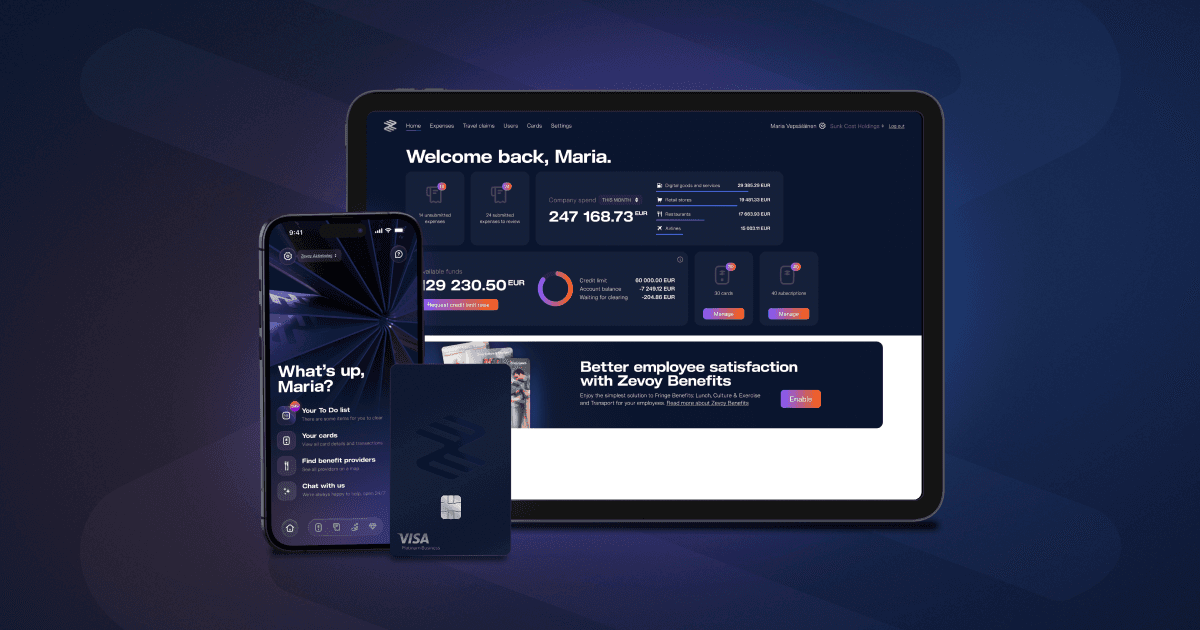
You want corporate cards and expense management in one platform, not a card plus Excel
You need expenses to post directly to your accounting system — Netvisor, Procountor, Fennoa, or others
Your employees travel and you need automatic per diem and mileage calculation
You want receipt management with OCR and ReceiptHero automatic digital receipts
You need approval workflows so managers can review expenses before they post
You want virtual cards and subscription management for SaaS services
You don't want to be locked into one bank for your expense payment card
You want to be set up in 30 minutes, not weeks
Feature | Zevoy | Danske Bank |
|---|---|---|
Corporate cards | ✅ Visa (physical + virtual) | ✅ Mastercard (Classic, Gold, Platinum) |
Virtual cards | ✅ Unlimited | ❌ |
Subscription cards | ✅ Dedicated card per service | ❌ |
Expense management platform | ✅ Built-in | ❌ No dedicated expense management platform (District is card management only) |
Receipt scanning (OCR) | ✅ | ❌ |
ReceiptHero auto-receipts | ✅ | ❌ |
Approval workflows | ✅ Multi-tier | ❌ |
Per diem (Finland) | ✅ Automatic rate calculation | ❌ |
Mileage claims (Finland) | ✅ Auto-calculated | ❌ |
Netvisor integration | ✅ Direct API | ❌ |
Procountor integration | ✅ Direct API | ❌ |
Total accounting systems | 27 | ⚠️ Enterprise ERP feeds (CDF 3 — supports Concur, SAP, Oracle, Visma) |
Regulatory status | EMI authorised and regulated by FIN-FSA · ISO 27001 certified · Cards under license from Visa Europe | Bank-issued under banking license |
Card data delivery | ✅ Real-time API | ⚠️ File export / host-to-host |
Onboarding time | 30 minutes | Weeks (bank process) |
Bank relationship required | ❌ Works with any bank | ✅ Danske Bank business account required |
Pricing | From €10/cardholder/mo + add-ons (Subscription cards €2.50, Claims users €5). €10 minimum service fee. | Annual card fees (Platinum 370 EUR/yr, Gold 85 EUR/yr, Classic 45 EUR/yr) |
Danske Bank corporate cards are a payment instrument with a card management portal (District). But there's no dedicated expense management platform, no receipt scanning, no approval workflows, no travel expense automation. With Zevoy, the card is the starting point — every transaction flows into expense management, gets matched with a receipt, goes through approval, and posts to your accounting system automatically.
Zevoy pushes expenses directly to Netvisor, Procountor, Fennoa, Heeros, Fivaldi, Lemonsoft, Visma L7, and 19 more accounting systems via API or dedicated export templates. Over 3,000 organisations across Northern Europe use Zevoy. Danske Bank offers CDF 3 (Mastercard Global Data Repository) feeds that support enterprise ERPs like Concur, SAP, Oracle, and Visma — but these are enterprise-grade data feeds, not SME-friendly accounting integrations. For most small and mid-sized companies, someone still has to manually process and reconcile card data.
Zevoy calculates Finnish and Swedish per diem (päivärahat / traktamente) automatically — domestic and international rates, multi-country trip legs, meal deductions, partial days. It also handles mileage (kilometrikorvaukset / milersättning). Danske Bank doesn't offer any travel expense features. If your employees travel, you need a separate tool or spreadsheet.
Can I use Zevoy if I bank with Danske Bank?
Yes. Zevoy works independently of your banking relationship. You can use Zevoy corporate cards alongside your Danske Bank business account. Many companies keep their main banking relationship and add Zevoy specifically for expense management.
Does Danske Bank have an expense management app?
Danske Bank offers the District platform for card management, but it is not an expense management platform. It does not include receipt scanning, approval workflows, or direct SME-friendly accounting integrations. Danske Bank does offer enterprise-grade CDF 3 data feeds for large organisations using Concur, SAP, Oracle, or Visma. For SMEs, you need a separate expense management tool.
What happens to my Danske Bank card data?
Danske Bank provides card transaction data via CDF 3 enterprise data feeds (supporting Concur, SAP, Oracle, Visma) or file exports for other customers. For SMEs not using enterprise ERPs, this data needs to be manually imported into your accounting or expense system. Zevoy sends card transactions directly to your accounting system via API.
Is Zevoy a bank?
No. Zevoy is an expense management platform that issues its own Visa corporate cards. Your company's funds stay in your existing bank account. Zevoy handles the card payments and expense workflow.
How fast can I switch from Danske Bank cards to Zevoy?
Zevoy onboarding takes about 30 minutes. Your team can start using Zevoy cards immediately after setup. You can phase out Danske Bank cards gradually as your team transitions.
Danske Bank offers Mastercard corporate cards for businesses. Zevoy combines Visa corporate cards with built-in expense management, accounting integrations, and travel expense automation. Here's what the difference means in practice.
Zevoy Aktiebolag
Eteläesplanadi 24 A
00130 Helsinki
Finland
Business ID: 3147751-4
Zevoy is a fintech company founded in 2020. Zevoy Aktiebolag is a Finnish electronic money institution regulated and authorized by the Finnish Financial Supervisory Authority. The company cards are issued by Zevoy Aktiebolag under a license from Visa Europe Limited. Our HQ is in Helsinki, Finland and in addition to our home market we also serve Sweden, Norway, Denmark, Germany, France, Belgium, The Netherlands, Spain, Portugal, Estonia, Lithuania and Latvia.